


My New York Research Trip in October 2024
- Bridget Walsh

- Dec 2, 2024
- 7 min read
I am writing a novel, ‘The Irish-American Girl’, about a young woman, Ellen Tuite, aged twenty-four, who is living and working in Manhattan. She begins to discover things about her family from her grandmother. One of them is that she has a previously unknown grandfather.
It begins in the summer of 1914 and the First World War threatens. The novel opens in Manhattan with the main characters: the grandmother, Jane Keating, her daughter, Anna, and granddaughter, Ellen. The two older women own and run a weekly newspaper and Ellen, the daughter/granddaughter, works there as a reporter and photographer.
My reasons for this research trip.
I have visited New York on a couple of occasions in the past and I have a fair idea of the layout of Manhattan. When I began writing an earlier novel, I used Google maps to visualise the places in my novel. For this latest work, earlier this year, I decided I would like to actually walk the locations in order to help me better understand my characters’ experiences. For example, I wanted to experience the distances between Central Park and the Dakota building, as well as the family newspaper offices and also the house where Ellen grew up in Greenwich village. Also, to see a little of what they would have seen at that time. So I booked a couple of weeks holiday in the United States.
My husband and I flew in to John F Kennedy Airport in early October. We spent five days in Manhattan and also spent some time in Washington DC seeing the sights. The New York visit was mainly for my research, apart from a fabulous afternoon at the Richard Roberts theatre on 42nd Street to see the musical, Hamilton.
My imagined family of Irish women and their lives in Manhattan.
In a previous novel, Jane Keating, had fled Ireland in the time of the Irish Famine, and settled in Boston until the death of her husband. She then moved to Manhattan in 1865 and bought a small printing business with living accommodation on the upper floors. The business was based near the Hudson River, just off Canal Street and, over time, Jane developed the business into a weekly advertising newspaper.
Jane's view across the Hudson.

Jane’s daughter, Anna, was born and grew up there.
At the time of the novel, in 1914, Anna, by then a woman of almost fifty, lived in a brownstone house on Perry Street in Greenwich Village and, following a divorce, raised her daughter, Ellen, there. Ellen, now twenty-four years old, lived above the newspaper in an apartment above her grandmother.
Midtown and Downtown neighbourhoods.
I wanted to see what the neighbourhoods around the newspaper office and Anna's house were like, so my husband and I took a bus down to North End Avenue/Warren Street. We started our walk at the Irish Hunger Memorial, located in Rockefeller Park, overlooking the Hudson River. It was a lovely early autumn morning with the sky a brilliant blue; clouds and sky reflected and glittered on the choppy surface of the river.
The Irish Hunger Memorial

On the outside of the Irish Hunger Memorial, the stone walls are inlaid with dozens of gleaming narrow brass strips engraved with quotes from the time of the Irish Famine. One of the strips remembered the generosity of the Choctaw Nation, who had suffered themselves on their Trail of Tears, and sent money to help feed the starving people of Ireland in 1847.
The Memorial is built of grey and blue granite stones and contains part of an actual Irish stone cottage incorporated into the design, although only the remnants of the cottage, half a wall with a fireplace, appeared to be incorporated into the site, with walls and a winding path to complete the setting. Most of the large stones were covered in dark green creeping ivy and grasses and cast a sombre mood over the area. Just beyond the memorial, which is set in a park, there are multi-story apartment blocks overlooking the river and the Memorial. A striking contrast to then and now, and a reminder of the continuity of the story of Irish emigrants to New York.
We strolled around the site, and reflected on the many thousands of people who had ended up on the shores of New York City seeking a new life.
Leaving the Famine Memorial we began our walk up alongside the Hudson River. This whole area along the river has been redeveloped into the Hudson River Park. By the 1960s the piers and dockyards along the west side of Manhattan had ceased to be used for shipping purposes and all had fallen into extreme disrepair. There are photographic displays along the walk showing pictures of derelict warehouses and rusty piers along the river. Today, the Hudson River Park is a beautiful walkway and promenade that stretches for miles along the west side of Manhattan. Its purpose is for New Yorkers and visitors to relax and enjoy the amazing setting that is Manhattan. There were many people out running, walking dogs, cycling, and some just enjoying a beautiful day by the river.
The Hudson River with New Jersey in the distance.

As we walked, I thought back to the early twentieth century when my characters lived there, and I imagined the river to be full of commercial shipping. The piers along the River Hudson would have been busy, back then, with ships arriving from and departing to all parts of the world. In my next novel, my character, Jane, was able to look out of her window just off Canal Street where the newspaper office is located, and catch a glimpse of the river.
We walked up past Canal Street and continued north for a mile or so until we came to the West Village and Perry Street where Anna lived. I took a picture of a lovely brownstone house, and decided that she could easily have lived in it. The Greenwich Village area was built in the 18th century and the streets are narrower and ‘off grid’ so not uniform, with some cobbled streets adding to the interest of the walk.
One thing I noticed on our walk was that New Jersey, across the river, was really close, I guess it is less than a mile across the River Hudson. Looking to my left, I could see and admire, in the distance, the Statue of Liberty and Ellis Island which would have been visible to my characters in nineteen-fourteen. My character, Jane Keating, the grandmother in this story, would have seen the statue being put up in 1886. Her granddaughter, Ellen, was born in 1890.
Technology and culture in 1914
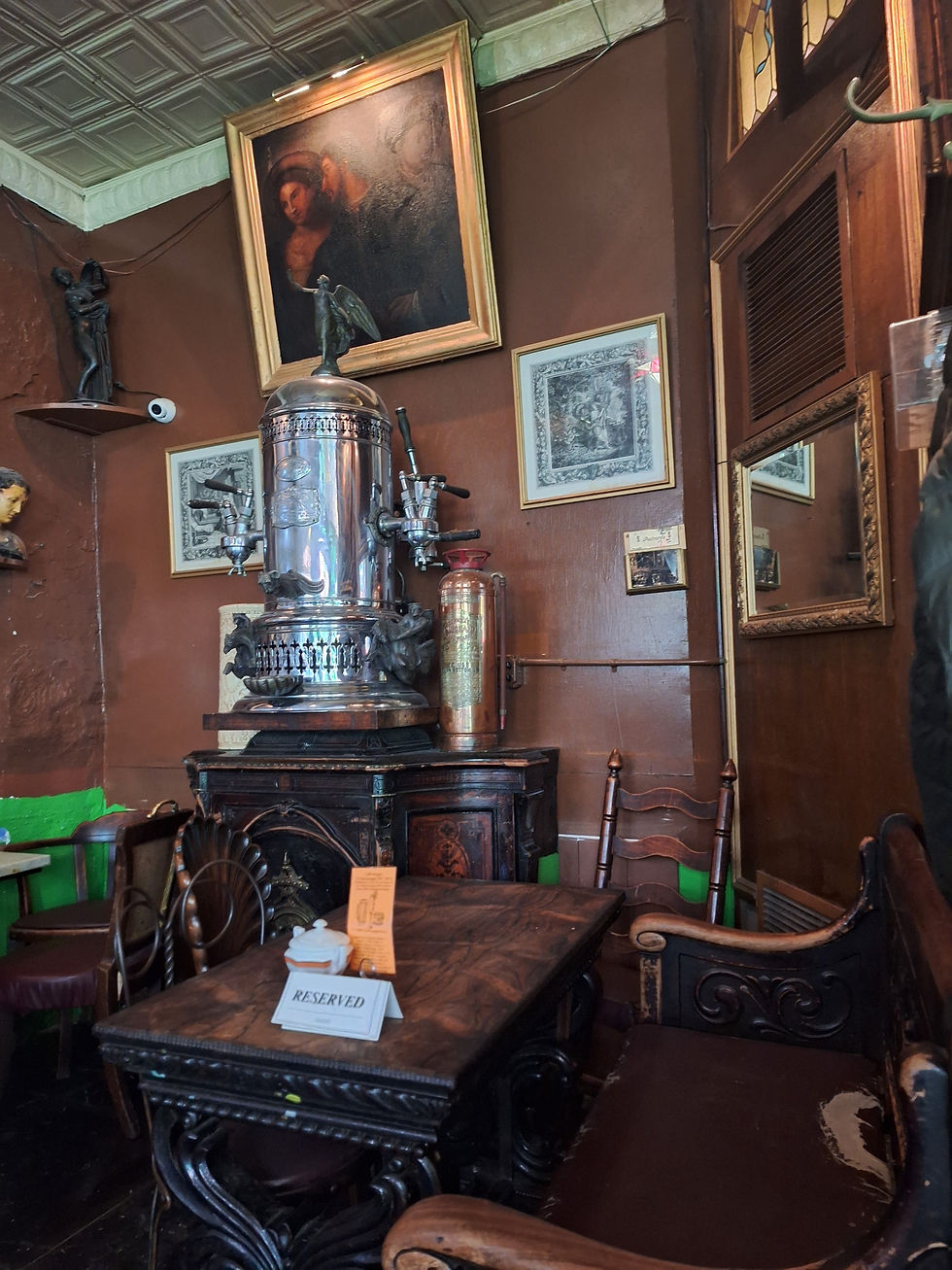
Another setting that I had written about in my novel was an Italian cafe with a coffee machine. A friend from my writing group, Christine Colliar, had recently been to New York and found a cafe, Caffe Reggio, with a coffee machine from that period, reputedly the first cappuccino machine in New York. She took a picture and sent it to me, so I was excited to seek it out on my visit. It was in a lovely situation, on MacDougal Street and West Third Street, not too far from Washington Square Park.
The cafe was almost exactly as I had imagined, and I could picture my character drinking her coffee in that small, very Italian place filled with old pictures of saints and statues, and with mirrors on all the walls. The centrepiece of the cafe was a large, silver coffee machine, a statue of a small silver angel stood on the top, and lots of levers and taps emphasised the complexity of preparing authentic italian coffee. This was one of the earliest Italian coffee machines in Manhattan and it was lovely to have that experience of sitting with my husband in such a historic, yet really busy place. And I could picture Ellen sipping an espresso with her friends. They were all the children of immigrants to New York.
Caffe Reggio
After our visit to Caffe Reggio we strolled to nearby Washington Square Park and sat on a bench in the sunshine to admire the huge monument to George Washington and listened to a quartet of jazz musicians busking. Then we caught a bus back up to Central Park and Seventh Avenue to our hotel. I was satisfied that I now had a good picture of the area my characters lived in.
Central Park and The Dakota.
Over the few days, I took several walks around Central Park. I was particularly interested in the Angel of the Lake as it is such a beautiful iconic place with lots of visitors.

Central Park is a wonderful place, and I got lost a couple of times, the paths seem to swirl in all directions. You think you’re going south, when you're actually going west. But it was a good idea to walk as it gave me an indication of where Ellen might want to park her new car when she was going to find her grandfather. Ellen had only recently learned about her Irish grandfather and then discovered that he lived in an apartment at the Dakota Building on 72nd Street, Central Park West. I originally wrote that Ellen drove to the Park and parked on 5th Avenue, but seeing the distance across the park it no longer made sense for her to do that.
It was amazing to stand outside the entrance to The Dakota and imagine one of my characters, having made his millions, living in an apartment overlooking Central Park.

Today, I think, it is most famous for being the home of John Lennon, former Beatle, who was shot and killed outside the main entrance back in December, 1980.
In conclusion, if you are a writer, or a reader, I recommend that you try to visit the places you write about as it will add authenticity to your writing, even when the places have changed beyond recognition over time. For example, the geographical locations such as the Hudson River and some historical buildings like the Dakota, will still be there.
I had a wonderful few days researching my characters’ settings and I really learnt a lot on my research trip.


Comments